
Gut vs Data-Driven Decision Making for Product Managers: Balancing Intuition and Analytics

Introduction:
In the world of product management, making decisions is crucial for success. There are two main ways to make decisions: using your gut feeling or relying on data. I have used both methods in my PM journey. Here, I would like to share my experience on when to use what, and we will explore the advantages and disadvantages of both methods, discuss real-life product scenarios, and explain how to combine both methods for better decision-making.
1) Gut and Data-Driven Decision Making Defined:
Gut-driven decision-making means making choices based on your feelings, experience, and instincts. It relies on what you personally think is best. Data-driven decision-making, on the other hand, involves using facts, numbers, and analysis to guide your choices. It focuses on using evidence to make decisions and reduce biases.
2) Advantages and Disadvantages of Gut and Data-Driven Approaches:
a) Gut-driven decision-making:
Advantages:
- Quick decision-making process
- Relies on your experience and intuition
- Can be helpful in uncertain situations
Disadvantages:
- Can be influenced by personal biases and opinions
- Limited by your own knowledge and perspective
- Difficult to measure or repeat the same results
b) Data-driven decision-making:
Advantages:
- Based on objective information
- Reduces biases and subjectivity
- Helps with scalability and consistency
Disadvantages:
- Takes time to collect and analyze data
- Incomplete or wrong data can lead to wrong decisions
- Doesn't always consider qualitative insights and context
3) When to Use Gut-Driven Decision-Making:
Gut-driven decision-making is most useful in the following situations:
- Early-stage startups with limited data
- When you need to respond quickly and be flexible
- When dealing with innovative or unique product ideas where data is scarce
Example: When deciding what features to include in a new product, your gut feeling, based on your experience, can provide valuable insights until you gather enough data.
4) When to Use Data-Driven Decision-Making:
Data-driven decision-making is beneficial in the following situations:
- Established businesses with a lot of historical data
- Complex problems that require a deep understanding
- When you need to identify patterns, trends, and user behaviors
Example: If you are analyzing user behavior data and testing different options to improve the onboarding process of a mobile app, using data-driven methods can help you make informed decisions based on user interactions.
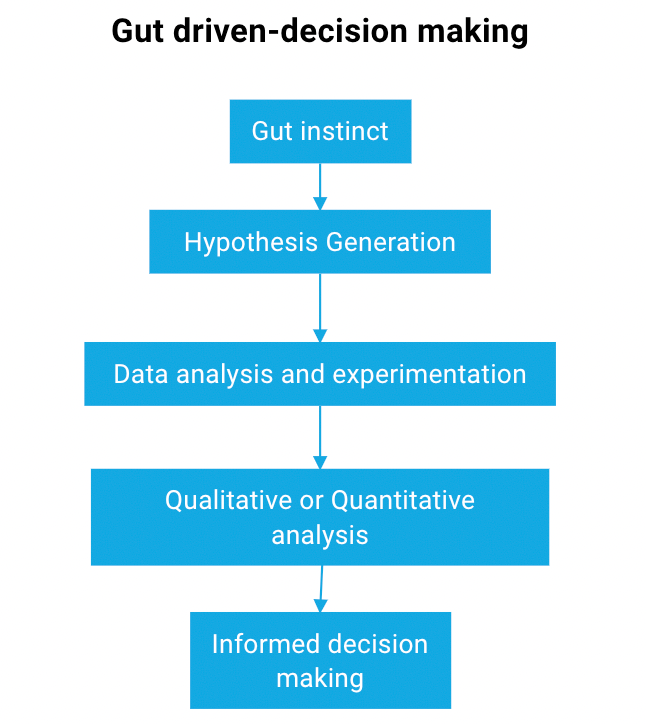
5) Combining Gut and Data-Driven Decision Making:
To make the best decisions, product managers can use a combination of both methods:
- Use your gut instinct to come up with ideas and potential solutions.
- Validate your ideas using data analysis and experiments.
- Consider qualitative insights from user feedback and market research.
- Continuously improve your decisions based on both data-backed insights and your instincts.
6) Conclusion:
In the dynamic field of product management, it's important to find a balance between gut-driven and data-driven decision-making. While your intuition and experience are valuable, using data provides objective insights and validation. By combining both methods effectively, product managers can make informed decisions, reduce risks, and achieve successful outcomes for their products.
Remember, gut-driven decisions bring the art of product management, while data-driven decisions provide the science. Embracing both allows product managers to make use of both their intuition and evidence, leading to greater product success.